Shut the Box: the variants
The game is played a little differently at every table. Here are the common versions, what they change — and which of them Pipfold lets you set. The base rules are on rules.
How many flaps — and how many dice
| Version | Dice | Starting total | How it plays |
|---|---|---|---|
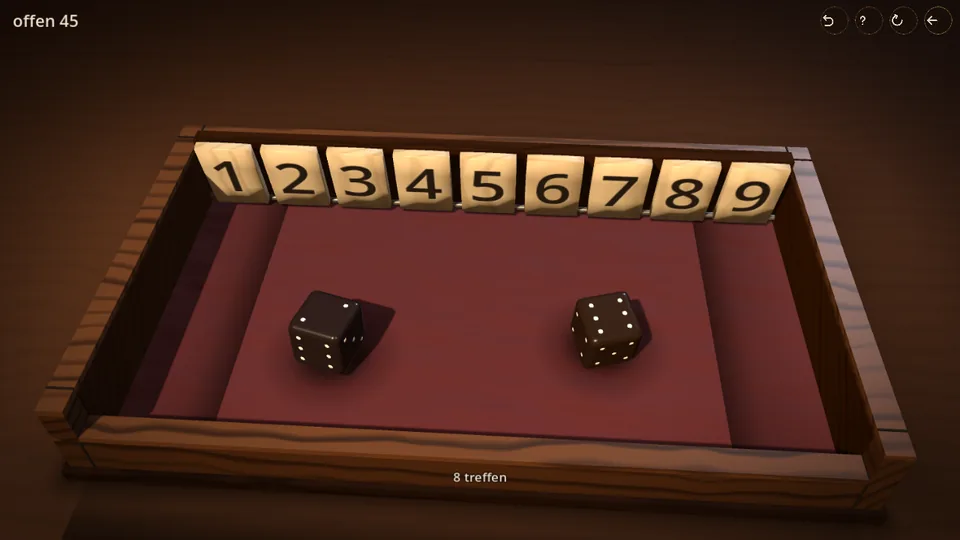
| Flaps 1–9 the classic | two | 45 | The version standing in most pubs. Two dice reach every number from 2 to 12, the row stops at 9 — so 10, 11 and 12 only work as combinations. |
| Flaps 1–10 | two | 55 | One flap more, the same two dice. Longer, and the endgame is harder: if the 10 is left standing alone, the pips must total exactly 10 — that is 3 rolls in 36. |
| Flaps 1–12 the big one | three | 78 | The third die belongs to it, otherwise 11 and 12 would only be reachable as combinations. Far more choices per roll — and more to get wrong. |
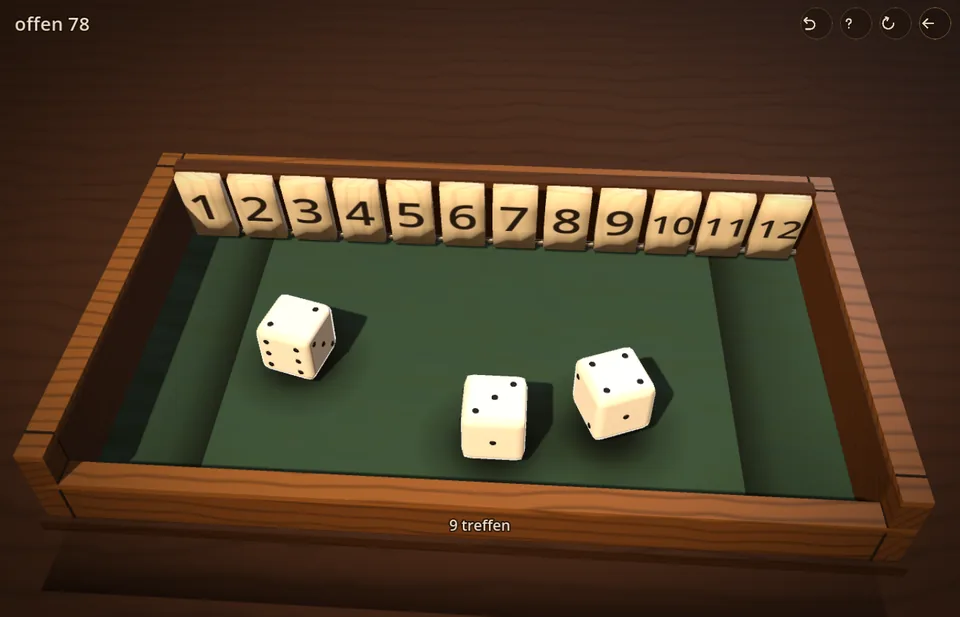
The same base rule holds in all three: as soon as the open total is at most 6·k, you may roll with k dice.
Extra rules
| Rule | What it changes |
|---|---|
| One die from 7 up | The classic pub rule: once every flap from 7 upwards is shut, you may roll a single die. It rewards clearing the big flaps first. |
| Single flaps only | No combinations — only what a single flap hits on its own counts. Much harder, and the rounds get short. |
| Plus and minus | The school and household variant: the target is any number you can build from the pips with + and −. From 6 and 5 you get 11 or 1. Classically only the sum counts — with this rule the board becomes an arithmetic game. |
| Same dice for everyone | With several players, everyone gets the same sequence of rolls. Then only the choices differ — no luck left in the comparison. |
All four sit in the game menu under „Settings“ and switch on individually. The default is the classic version: 1–9, two dice, combinations allowed, sum only.
House rules we do not implement
Shut the Box is in the public domain, so it is played differently everywhere. You will meet these rules — and Pipfold does notimplement them:
- Doubles. Depending on the table a double grants another roll or a free choice of flap. There is no binding version — here a double counts as an ordinary roll.
- Stake and pot. In pubs the game is also played for a stake that goes to whoever shuts the box. Here there is nothing to stake and nothing to win — the game knows no money and no currency.
Wood and sound
Not a rule, but the question comes up: the box comes in three woods —maple, walnut and ash, each with its own felt. Plus a hard-contrast version for weak sight or bright daylight. Sound and motion can both be switched off; the system setting for reduced motion is respected anyway.
Next
- The base rules — with one round played all the way through.
- Two, three or four players — taking turns on one device, optionally as a tournament.
- Play now — every variant is set in the start menu.